
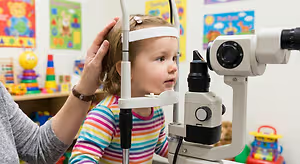
Lazy eye is one of the most common causes of vision loss in childhood, yet many children never mention a problem. Their brains gradually favor one eye, and the weaker eye may not develop normal sight. Because young children tend to assume everyone sees the world the way they do, parents are often the first to notice that something looks off. Learning the lazy eye signs in children to watch for can help you decide when a comprehensive eye exam is needed.
For families in Raleigh, North Carolina, early attention makes a meaningful difference, because the visual system is most responsive to treatment during childhood.
What Is Lazy Eye?
Lazy eye, known medically as amblyopia, is a developmental condition in which vision in one eye fails to develop fully. The brain learns to rely on the stronger eye and gradually ignores signals from the weaker one. Glasses alone may not fix the problem, since the brain has already adapted to the imbalance.
Amblyopia affects roughly 2 to 3 percent of children, and it is one of the leading causes of vision loss in one eye among young people. It often develops alongside a few other conditions, including strabismus (an eye turn), significant differences in prescription between the two eyes, or a childhood cataract.
What Are the Signs of Lazy Eye in Children?
Some signs are easy to spot, while others only appear during everyday activities. Watch for:
- An eye that turns inward, outward, up, or down, especially when tired or looking at something close
- Squinting or closing one eye, particularly in bright sunlight
- Tilting the head or covering one eye to see better
- Poor depth perception, such as misjudging distances when reaching for objects or catching a ball
- Holding books, tablets, or toys very close
- Clumsiness or frequent bumping into things on one side
- Eye rubbing, headaches, or tiredness after reading or close work
Children with amblyopia often do not complain, since they may not know that the vision in one eye is different. A child who seems to have trouble with reading, coordination, or sports may benefit from a closer look from a pediatric eye care optometrist.
When Should Children Have an Eye Exam?
The American Optometric Association recommends a first eye exam at 6 to 12 months of age, another between ages 3 and 5, and a yearly exam once school begins. Catching amblyopia early gives treatment the best chance to succeed, which is why these visits matter even when a child appears to see normally.
A comprehensive eye exam checks more than distance vision. The optometrist evaluates each eye separately, looks at how the eyes work together, and measures the prescription in both eyes. These steps can reveal early differences that a basic school screening may miss.
What Does Amblyopia Treatment Involve?
Treatment depends on the cause and severity of the condition, as well as the child’s age. Common approaches include corrective glasses when a prescription is needed, patching the stronger eye to encourage use of the weaker one, and prescription eye drops in some cases. Vision therapy may also be recommended for certain coordination concerns.
Treatment works best when started early, and the visual system is most adaptable during the younger years. Older children and teens can still benefit in many cases, although progress may be slower. Results vary, so ongoing follow-up helps track changes and adjust the plan.
Is Lazy Eye Something Parents Can Prevent?
Not every case can be prevented, but early detection and regular exams help catch problems sooner. Keeping children’s routine vision checkups on schedule, paying attention to changes in how they use their eyes, and reporting any eye turn or squinting to the eye doctor can all make a difference.
Eye Care for Children at Greenway Vision Studio
The pediatric team at Greenway Vision Studio focuses on how a child’s vision develops over time, from comfortable reading and screen use to coordination and everyday play. If you have noticed any of the signs described here, or you simply want a baseline evaluation, the team can review your child’s eyes and explain next steps in plain language.